Scenarios for the Future of Technology and International Development Rockefeller Foundation 2010

The Rockefeller Foundation Scenarios for the Future of Technology and International Development 2010

An economically unstable and shock-prone world in which governments weaken, criminals thrive, and dangerous innovations emerge.
Rockefeller Plan to Use Bioweapons 
to Impose Martial Law One Quarantine at a Time
E X C E R P T S  –  B E L O W
An economically unstable and shock-prone world in which governments weaken, criminals thrive, and dangerous innovations emerge . . .
An economically depressed world in which individuals and communities develop localized, “makeshift” solutions to a growing set of problems . . .
One important-and novel-component of our strategy toolkit is scenario planning, a process of creating narratives about the future based on factors likely to affect a particular set of challenges and opportunities. We believe that scenario planning has great potential for use in philanthropy to identify unique interventions, simulate and rehearse important decisions that could have profound implications, and highlight previously undiscovered areas of connection and intersection. Most important, by providing a methodological structure that helps us focus on what we don’t know-instead of what we already know-scenario planning allows us to achieve impact more effectively.
The Rockefeller Foundation’s use of scenario planning to explore technology and international development has been both inspired and ambitious. Throughout my 40-plus-year career as a scenario planner, I have worked with many of the world’s leading companies, governments, foundations, and nonprofits-and I know firsthand the power of the approach. Scenario planning is a powerful tool precisely because the future is unpredictable and shaped by many interacting variables.
Finally, a note about what we mean by “technology.” In this report, we use the term to refer to a broad spectrum of tools and methods of organization. Technologies can range from tools for basic survival, such as a treadle pump and basic filtration technologies, to more advanced innovations, such as methods of collecting
and utilizing data in health informatics and novel building materials with real-time environmental sensing capabilities.
The Rockefeller Foundation and GBN began the scenario process by surfacing a host of driving forces that would affect the future of technology and international development. These forces were generated through both secondary research and in-depth interviews with Foundation staff, Foundation grantees, and external experts.
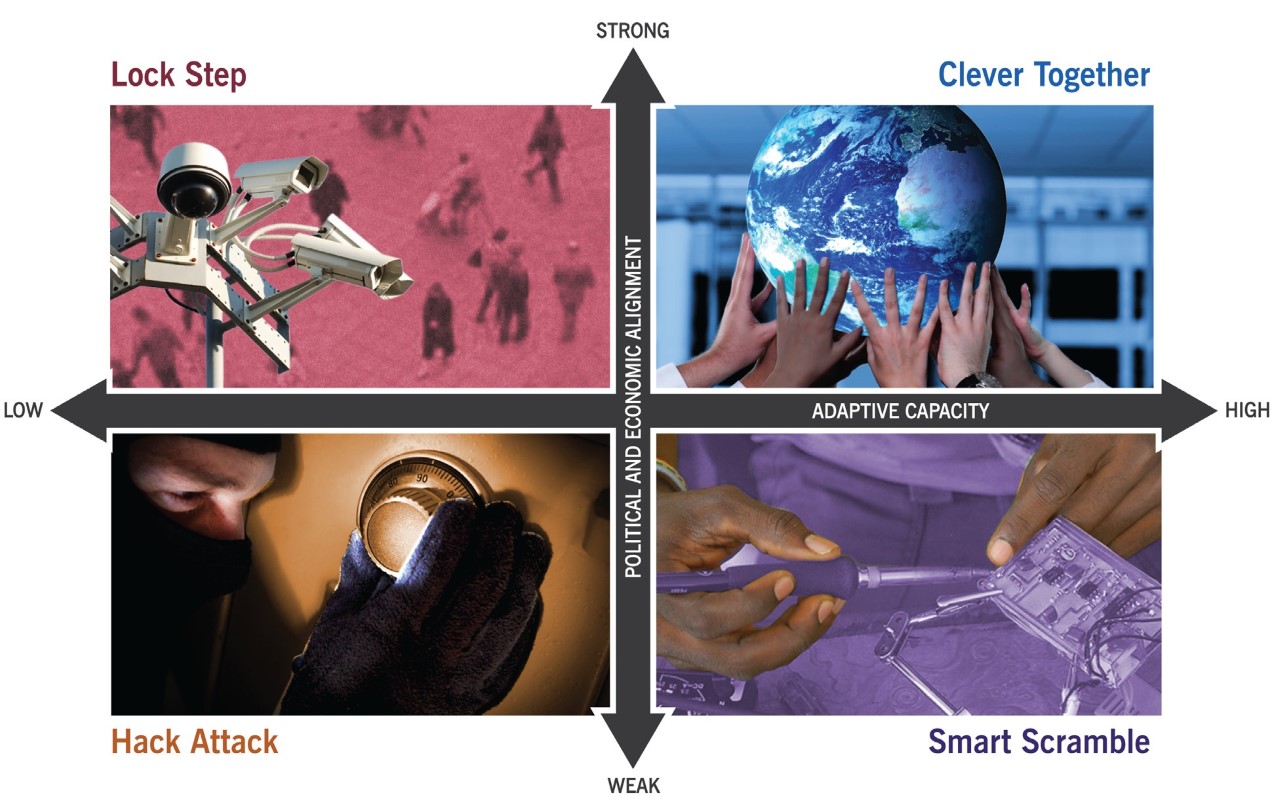
Two uncertainties from a longer list of potential uncertainties that might shape the broader contextual environment of the scenarios, including social, technology, economic, environmental, and political trends.
Bottom-up and top-down. Lower levels of adaptive capacity emerge in the absence of these characteristics and leave populations particularly vulnerable to the disruptive effects of unanticipated shocks.
Once crossed, these axes create a matrix of four very different futures:
LOCK STEP – A world of tighter top-down government control and more authoritarian eadership, with limited innovation and growing citizen pushback
CLEVER TOGETHER – A world in which highly coordinated and successful strategies emerge for addressing both urgent and entrenched worldwide issues
HACK ATTACK – An economically unstable and shock-prone world in which governments weaken, criminals thrive, and dangerous innovations emerge
SMART SCRAMBLE – An economically depressed world in which individuals and communities develop localized, makeshift solutions to a growing set of problems
Each scenario tells a story of how the world, and in particular the developing world, might progress over the next 15 to 20 years.
We now invite you to immerse yourself in each future world and consider four different visions for the evolution of technology and international development to 2030.
Rockefeller Plan to Use Bioweapons to Impose Martial Law One Quarantine at a Time.
Page 18
LOCK STEP
A world of tighter top-down government control and more authoritarian leadership, with limited innovation and growing citizen pushback
In 2012, the pandemic that the world had been anticipating for years finally hit. Unlike 2009’s H1N1, this new influenza strain-originating from wild geese-was extremely virulent and deadly. Even the most pandemic-prepared nations were quickly overwhelmed when the virus streaked around the world, infecting nearly 20 percent of the global population and killing 8 million in just seven months, the majority of them healthy young adults. The pandemic also had a deadly effect on economies: international mobility of both people and goods screeched to a halt, debilitating industries like tourism and breaking global supply chains. Even locally, normally bustling shops and office buildings sat empty for months, devoid of both employees and customers.
The pandemic blanketed the planet-though disproportionate numbers died in Africa, Southeast Asia, and Central America, where the virus spread like wildfire in the absence of official containment protocols. But even
in developed countries, containment was a challenge. The United States’s initial policy of “strongly discouraging” citizens from flying proved deadly in its leniency, accelerating the spread of the virus not just within the U.S. but across borders. However, a few countries did fare better-China in particular. The Chinese government’s quick imposition and enforcement of mandatory quarantine for all citizens, as well as its instant and near-hermetic sealing off of all borders, saved millions of lives, stopping the spread of the virus far earlier than in other countries and enabling a swifter post- pandemic recovery.
China’s government was not the only one that took extreme measures to protect its citizens from risk and exposure. During the pandemic, national leaders around the world flexed their authority and imposed airtight rules and restrictions, from the mandatory wearing of face masks to body-temperature checks at the entries to communal spaces like train stations and supermarkets. Even after the pandemic faded, this more authoritarian control and oversight of citizens and their activities stuck and even intensified. In order to protect themselves from the spread of increasingly global problems-from pandemics and transnational terrorism to environmental crises and rising poverty-leaders around the world took a firmer grip on power.
At first, the notion of a more controlled world gained wide acceptance and approval. Citizens willingly gave up some of their sovereignty-and their privacy-to more paternalistic states in exchange for greater safety and stability. Citizens were more tolerant, and even eager, for top-down direction and oversight, and national leaders had more latitude to impose order in the ways they saw fit. In developed countries, this heightened oversight took many forms: biometric IDs for all citizens, for example, and tighter regulation of key industries whose stability was deemed vital to national interests. In many developed countries, enforced cooperation with a suite of new regulations and agreements slowly but steadily restored both order and, importantly, economic growth.
Across the developing world, however, the story was different-and much more variable. Top-down authority took different forms in different countries, hinging largely on the capacity, caliber, and intentions of their leaders.
More authoritarian leadership worked less well-and in some cases tragically-in countries run by irresponsible elites who used their increased power to pursue their own interests at the expense of their citizens.
There were other downsides, as the rise of virulent nationalism created new hazards.
By 2025, people seemed to be growing weary of so much top-down control and letting leaders and authorities make choices for them.
Wherever national interests clashed with individual interests, there was conflict. Sporadic pushback became increasingly organized and coordinated, as disaffected youth and people who had seen their status and opportunities slip away-largely in developing countries-incited civil unrest. In 2026, protestors in Nigeria brought down the government, fed up with the entrenched cronyism and corruption. Even those who liked the greater stability and predictability of this world began to grow uncomfortable and constrained by so many tight rules and by the strictness of national boundaries. The feeling lingered that sooner or later, something would inevitably upset the neat order that the world’s governments had worked so hard to establish. *
“IT IS POSSIBLE TO DISCIPLINE AND CONTROL SOME SOCIETIES FOR SOME TIME, BUT NOT THE WHOLE WORLD ALL THE TIME.” – GK Bhat, TARU Leading Edge, India
_____________________________________________________________
Scenario Narratives LOCK STEP HEADLINES IN LOCK STEP
Quarantine Restricts In-Person Contact; Cellular Networks Overloaded (2013)
Vietnam to Require ‘A Solar Panel
on Every Home’ (2022)
African Leaders Fear Repeat of Nigeria’s 2026 Government Collapse (2028)   5
Intercontinental Trade Hit by Strict Pathogen Controls (2015)
Italy Addresses ‘Immigrant Caregiver’ Gap with Robots (2017)020
Will Africa’s Embrace of Authoritarian Capitalism a la China Continue? (2018)025
Proliferating Trade Networks in Eastern and Southern Africa Strengthen Regional Ties (2023)
 Page 22
Many governments will place severe restrictions on the program areas and geographies that international philanthropies can work in, leading to a narrower and stronger geographic focus or grant-making in their home country only.
Technological innovation in “Lock Step” is largely driven by government and is focused on issues of national security and health and safety. Most technological improvements are created by and for developed countries, shaped by governments’ dual desire to control and to monitor their citizens. 
Technology trends and applications we might see:
  • Scanners using advanced functional magnetic resonance imaging (fMRI) technology become the norm at airports and other public areas to detect abnormal behavior that may indicate “antisocial intent.”
  • In the aftermath of pandemic scares, smarter packaging for food and beverages is applied first by big companies and producers in a business-to-business environment, and then adopted for individual products and consumers.
  • New diagnostics are developed to detect communicable diseases. The application of health screening also changes; screening becomes a prerequisite for release from a hospital or prison, successfully slowing the spread of many diseases.
  • Tele-presence technologies respond to the demand for less expensive, lower- bandwidth, sophisticated communications systems for populations whose travel is restricted.
  • Driven by protectionism and national security concerns, nations create their own independent, regionally defined IT networks, mimicking China’s firewalls. Governments have varying degrees of success in policing internet traffic, but these efforts nevertheless fracture the “World Wide” Web.
Page 24
EXAMPLE:
It was now 2025. Manisha was 27 years old and a manager for the Indian government’s Ganges Purification Initiative (GPI). Until recently, the Ganges was still one of the most polluted rivers in the world, its coliform bacteria levels astronomical due to the frequent disposal of human and animal corpses and of sewage (back in 2010, 89 million liters per day) directly into the river. Dozens of organized attempts to clean the Ganges over the years had failed. In 2009, the World Bank even loaned India $1 billion to support the government’s multi-billion dollar cleanup initiative. But then the pandemic hit, and that funding dried up.
Now in 2020 Many top Indian scientists and engineers had been recruited by the government to develop tools and strategies for cleaning the Ganges in more high-tech ways. Her favorite were the submersible bots that continuously “swam” the river to detect, through sensors, the presence of chemical pathogens. New riverside filtration systems that sucked in dirty river water and spit out far cleaner water were also impressive-especially because on the outside they were designed to look like mini-temples. In fact, that’s why Manisha was at the river today, to oversee the installation of a filtration system located not even 100 feet from where she first stepped into the Ganges as a girl. The water looked so much cleaner now, and recent tests suggested that it might even meet drinkability standards by 2035. Manisha was tempted to kick off her shoe and dip her toe in, but this was a restricted area now-and she, of all people, would never break that law.
Page 26
The recession of 2008-10 did not turn into the decades-long global economic slide that many had feared. In fact, quite the opposite: strong global growth returned in force, with the world headed once again toward the demographic
and economic projections forecasted before the downturn. India and China were on track to see their middle classes explode to 1 billion by 2020. Mega-cities like Sao Paulo and Jakarta expanded at a blistering pace as millions poured in from rural areas. Countries raced to industrialize by whatever means necessary; the global marketplace bustled.
But two big problems loomed. First, not all people and places benefited equally from this return to globalized growth: all boats were rising, but some were clearly rising more. Second, those hell-bent on development and expansion largely ignored the very real environmental consequences of their unrestricted growth. Undeniably, the planet’s climate was becoming increasingly unstable.
Sea levels were rising fast, even as countries continued to build-out coastal mega-cities. In 2014, the Hudson River overflowed into New York City during a storm surge, turning the World Trade Center site into a three-foot-deep lake. The image of motorboats navigating through lower Manhattan jarred the world’s most powerful nations into realizing that climate change was not just a developing-world problem. That same year, new measurements showing that atmospheric carbon dioxide levels were climbing precipitously created new urgency and pressure for governments (really, for everyone) to do something fast.
International coordination started slowly, then accelerated faster than anyone had imagined. In 2015, a critical mass of middle income and developed countries with strong economic growth publicly committed to leveraging their resources against global-scale problems, beginning with climate change. Together, their governments hashed out plans for monitoring and reducing greenhouse gas emissions in the short term and improving the absorptive capacity of the natural environment over the long term. In 2017, an international agreement was reached on carbon sequestration (by then, most multinational corporations had a chief carbon officer) and intellectual and financial resources were pooled to build out carbon capture processes that would best support the global ecosystem.
A functioning global cap and trade system was also established.
Worldwide, the pressure to reduce waste and increase efficiency in planet-friendly ways was enormous. New globally coordinated systems for monitoring energy use capacity-including smart grids and bottom-up pattern recognition technologies-were rolled out.
Centralized global oversight and governance structures sprang up, not just for energy use but also for disease and technology standards. Such systems and structures required far greater levels of transparency, which in turn required more tech-enabled data collection, processing, and feedback.
Enormous, benign “surveillance” systems allowed citizens to access data-all publically available-in real time and react.
Nation-states lost some of their power and importance as global architecture strengthened and regional governance structures emerged.
International oversight entities like the UN took on new levels of authority, as did regional systems like the Association of Southeast Asian Nations (ASEAN), the New Partnership for Africa’s Development (NEPAD), and the Asian Development Bank (ADB). The worldwide spirit.
Page 28
“WHAT IS OFTEN SURPRISING ABOUT NEW TECHNOLOGIES IS COLLATERAL DAMAGE: THE EXTENT OF THE PROBLEM THAT YOU CAN CREATE BY SOLVING ANOTHER PROBLEM IS ALWAYS A BIT OF A SURPRISE.” – Michael Free, Program for Appropriate
Technology in Health (PATH)
HACK ATTACK
An economically unstable and shock-prone world in which governments weaken, criminals thrive, and dangerous innovations emerge
  • The cost of capturing data through nanosensors and smart networks falls precipitously. In many developing countries, this leads to a proliferation of new and useful services, including “sousveillance” mechanisms that improve governance and enable more efficient use of government resources.
  • Intelligent electricity, water distribution, and transportation systems develop in urban areas. In these “smart cities,” internet access is seen as a basic right by the late 2010s.
    Technology trends and applications we might see:
    • Advances in low-cost mind-controlled prosthetics aid the 80 percent of global amputees who live in developing countries.
    • Solar power is made vastly more efficient through advances in materials, including polymers and nanoparticles. An effective combination of government subsidies and microfinance means solar is used for everything from desalination for agriculture to wi-fi networks.
    • Flexible and rapid mobile payment systems drive dynamic economic growth in the developing world, while the developed world is hampered by entrenched banking interests and regulation.
      Page 37
      Despite such efforts, the global have/have- not gap grew wider than ever. The very rich still had the financial means to protect themselves; gated communities sprung up from New York to Lagos, providing safe havens surrounded by slums. In 2025, it was de rigueur to build not
      a house but a high-walled fortress, guarded by armed personnel. The wealthy also capitalized on the loose regulatory environment to experiment with advanced medical treatments and other under-the-radar activities.
      Those who couldn’t buy their way out of chaos-which was most people-retreated
      to whatever “safety” they could find. With opportunity frozen and global mobility at a near standstill-no place wanted more people, especially more poor people-it was often a retreat to the familiar: family ties, religious beliefs, or even national allegiance. Trust was afforded to those who guaranteed safety and survival-whether it was a warlord, an evangelical preacher, or a mother. In some places, the collapse of state capacity led to a resurgence of feudalism. In other areas, people managed to create more resilient communities operating as isolated micro versions of formerly large-scale systems. The weakening of national governments also enabled grassroots movements to form and grow, creating rays of hope amid the bleakness. By 2030, the distinction between “developed” and “developing” nations no longer seemed particularly descriptive or relevant. * 
     
Page 18
Think Tanks – Rand etc. operations of death
Debilitating tourism and economies.
National Security Memorandum No. 200
Depopulation
CDC owns Patent on Ebola
Curfews and quarantine.
Page 28
Strong alliances laid the groundwork for more global and participatory attempts to solve big problems.
More effective vaccines improved healthcare.
Pharmaceuticals giants released thousands of drug compounds shown to be effective against diseases like malaria into the public domain
as part of an “open innovation” agenda; they also opened their archives of R&D on neglected diseases deemed not commercially viable, offering seed funding to scientists who wanted to carry the research forward.
There was a push for major innovations in energy and water for the developing world, as those areas were thought to be the key to improving equity.
In many places, traditional social barriers to overcoming poverty grew less relevant as more people gained access to a spectrum of useful technologies-from disposable computers to do- it-yourself (DIY) windmills.
Given the circumstances that forced these new heights of global cooperation and responsibility, it was no surprise that much of the growth
in the developing world was achieved more cleanly and more “greenly.”
In Africa, there was a big push for solar energy, as the physical geography and low population density of much of the continent enabled the proliferation of solar farms. The Desertec initiative to create massive thermal electricity plants to supply both North Africa and, via undersea cable lines, Southern Europe was a huge success.
By 2025, a majority of electricity in the Maghreb was coming from solar, with exports of that power earning valuable foreign currency. The switch to solar created new “sun” jobs, drastically cut CO2 emissions, and earned governments billions annually. India exploited its geography to create similar “solar valleys” while decentralized solar- powered drip irrigation systems became popular in sub-Saharan Africa.
There were still failed states and places with few resources. Moreover, such rapid progress had created new problems. Rising consumption standards unexpectedly ushered in a new set of pressures: the improved food distribution system, for example, generated a food production crisis due to greater demand.
Demand for everything was growing exponentially.
By 2028, despite ongoing efforts to guide “smart growth,” it was becoming clear that the world could not support such rapid growth forever. *
Page 30
HEADLINES IN CLEVER TOGETHER
Global Economy Turns the Corner (2011)
Radical U.S. and China Emission Targets Signal New Era in Climate Change Negotiations (2015)
A First: U.S. Solar
Power Cheaper than Coal
(2020) Shortages Loom (2027)
‘Info Cruncher’ Is Grads’ Job of Choice as Data Era Dawns (2016)
Consortium of Foundations Launches Third Green Revolution as Food
Green Infrastructure Reshapes Economic Landscape
(2018)
Transparency International Reports 10th Consecutive Year of Improved Governance (2025)
Technology trends and applications we might see:
  • The cost of capturing data through nanosensors and smart networks falls precipitously. In many developing countries, this leads to a proliferation of new and useful services, including “sousveillance” mechanisms that improve governance and enable more efficient use of government resources.
  • Intelligent electricity, water distribution, and transportation systems develop in urban areas. In these “smart cities,” internet access is seen as a basic right by the late 2010s.
  • A malaria vaccine is developed and deployed broadly-saving millions of lives in the developing world.
  • Advances in low-cost mind-controlled prosthetics aid the 80 percent of global amputees who live in developing countries.
  • Solar power is made vastly more efficient through advances in materials, including polymers and nanoparticles. An effective combination of government subsidies and microfinance means solar is used for everything from desalination for agriculture to wi-fi networks.
  • Flexible and rapid mobile payment systems drive dynamic economic growth in the developing world, while the developed world is hampered by entrenched banking interests and regulations.
  Page 32
Research teams had been working for months to fabricate a new meat product-one that tasted just like beef yet actually contained only 50 percent meat; the remaining half was a combination of synthetic meat, fortified grains, and nano-flavoring.
In cities and villages around the world where children used to be hungry, access to higher-calorie meals had produced alarming increases in the incidence of obesity and diabetes. The demand for meat, in particular, was rising, but adding more animals to the planet created its own set of problems, such as more methane and spiking water demand.
Page 34
HACK ATTACK
An economically unstable and shock-prone
world in which governments weaken, criminals thrive, and dangerous innovations emerge
Devastating shocks like September 11, the Southeast Asian tsunami of 2004, and the 2010 Haiti earthquake had certainly primed the world for sudden disasters. But no one was prepared for a world in which large-scale catastrophes would occur with such breathtaking frequency. The years 2010 to 2020 were dubbed the “doom decade” for good reason: the 2012 Olympic bombing, which killed 13,000, was followed closely by an earthquake in Indonesia killing 40,000, a tsunami that almost wiped out Nicaragua, and the onset of the West China Famine, caused by a once-in-a-millennium drought linked to climate change.
Not surprisingly, this opening series of deadly asynchronous catastrophes (there were more) put enormous pressure on an already overstressed global economy that had entered the decade still in recession. Massive humanitarian relief efforts cost vast sums of money, but the primary sources-from aid agencies to developed-world governments-had run out of funds to offer. Most nation-states could no longer afford their locked-in costs, let alone respond to increased citizen demands for more security, more healthcare coverage, more social programs and services, and more infrastructure repair. In 2014, when mudslides in Lima buried thousands, only minimal help trickled in, prompting the Economist headline: “Is the Planet Finally Bankrupt?”
These dire circumstances forced tough tradeoffs. In 2015, the U.S. reallocated a large share of its defense spending to domestic concerns, pulling out of Afghanistan-where the resurgent Taliban seized power once again. In Europe, Asia, South America, and Africa, more and more nation- states lost control of their public finances, along with the capacity to help their citizens and retain stability and order. Resource scarcities and trade disputes, together with severe economic and climate stresses, pushed many alliances and partnerships to the breaking point; they also sparked proxy wars and low-level conflict in resource-rich parts of the developing world. Nations raised trade barriers in order to protect their domestic sectors against imports and-in the face of global food and resource shortages-to reduce exports of agricultural produce and other commodities.
With government power weakened, order rapidly disintegrating, and safety nets evaporating, violence and crime grew more rampant. Countries with ethnic, religious, or class divisions saw especially sharp spikes in hostility: Naxalite separatists dramatically expanded their guerrilla campaign in East India; Israeli- Palestinian bloodshed escalated; and across Africa, fights over resources erupted along ethnic or tribal lines. Meanwhile, overtaxed militaries and police forces could do little to stop growing communities of criminals and terrorists from gaining power. Technology-enabled gangs and networked criminal enterprises exploited both the weakness of states and the desperation of individuals. With increasing ease, these “global guerillas” moved illicit products through underground channels from poor producer countries to markets in the developed world. Using retired 727s and other rogue aircraft, they crisscrossed the Atlantic, from South America to Africa, transporting cocaine, weapons, and operatives. Drug and gun money became a common recruiting tool for the desperately poor.
Criminal networks also grew highly skilled at counterfeiting licit goods through reverse engineering. Many of these “rip-offs” and copycats were of poor quality or downright dangerous. In the context of weak health systems, corruption, and inattention to standards-either within countries or from global bodies like the World Health Organization-tainted vaccines entered the public health systems of several African countries. In 2021, 600 children in Cote d’Ivoire died from a bogus Hepatitis B vaccine, which paled in comparison to the scandal sparked by mass deaths from a tainted anti-malarial drug years later. The deaths and resulting scandals sharply affected public confidence in vaccine delivery; parents not just in Africa but elsewhere began to avoid vaccinating their children.
Technology hackers were also hard at work. Internet scams and pyramid schemes plagued inboxes. Meanwhile, more sophisticated hackers attempted to take down corporations, government systems, and banks via phishing scams and database information heists, and their many successes generated billions of dollars in losses. Desperate to protect themselves and their intellectual property, the few multinationals still thriving enacted strong, increasingly complex defensive measures. Patent applications skyrocketed and patent thickets proliferated, as companies fought to claim and control even the tiniest innovations. Security measures and screenings tightened.
This “wild west” environment had a profound impact on innovation. The threat of being hacked and the presence of so many thefts and fakes lowered the incentives to create “me first” rather than “me too” technologies. And so many patent thickets made the cross-pollination of ideas and research difficult at best. Blockbuster pharmaceuticals quickly became artifacts of the past, replaced by increased production of generics. Breakthrough innovations still happened in various industries, but they were focused more on technologies that could not be easily replicated or re-engineered. And once created, they were vigorously guarded by their inventors-or even by their nations. In 2022, a biofuel breakthrough in Brazil was protected as a national treasure and used as a bargaining chip in trade with other countries.
Verifying the authenticity of anything was increasingly difficult.
page 37
Recognized seals of safety and approval proved ineffective when even those seals were hacked. The positive effects of the mobile and internet revolutions were tempered by their increasing fragility as scamming and viruses proliferated, preventing these networks from achieving the reliability required to become the backbone of developing economies-or a source of trustworthy information for anybody.
Interestingly, not all of the “hacking” was bad. Genetically modified crops (GMOs) and do-it- yourself (DIY) biotech became backyard and garage activities, producing important advances. In 2017, a network of renegade African scientists who had returned to their home countries after working in Western multinationals unveiled the first of a range of new GMOs that boosted agricultural productivity on the continent.
But despite such efforts, the global have/have- not gap grew wider than ever. The very rich still had the financial means to protect themselves; gated communities sprung up from New York
to Lagos, providing safe havens surrounded by slums. In 2025, it was de rigueur to build not
a house but a high-walled fortress, guarded by armed personnel. The wealthy also capitalized on the loose regulatory environment to experiment with advanced medical treatments and other under-the-radar activities.
Those who couldn’t buy their way out of chaos-which was most people-retreated
to whatever “safety” they could find. With opportunity frozen and global mobility at a near standstill-no place wanted more people, especially more poor people-it was often a retreat to the familiar: family ties, religious beliefs, or even national allegiance. Trust was afforded to those who guaranteed safety and survival-whether it was a warlord, an evangelical preacher, or a mother. In some places, the collapse of state capacity led to a resurgence of feudalism. In other areas, people managed to create more resilient communities operating as isolated micro versions of formerly large-scale systems. The weakening of national governments also enabled grassroots movements to form and grow, creating rays of hope amid the bleakness. By 2030, the distinction between “developed” and “developing” nations no longer seemed particularly descriptive or relevant. *
Page 38
HEADLINES IN HACK ATTACK
Millennium Development Goals Pushed Back to 2020 (2012)
2010
Violence Against Minorities and Immigrants Spikes Across Asia (2014)
Islamic Terror
Networks Thrive in Doctors Without Borders
Latin America Confined Within Borders (2016) (2020)
Warlords Dispense Vital Medicines to Southeast Asian Communities (2028)030
India-Pakistan Water War Rages (2027)015 2020
Congo Death Toll Hits 10,000 in Malaria Drug Scandal (2018)2025
Nations Struggling with Resource Constraints Race to Scale Synthetic Biology (2021)
Page 38
Philanthropy is less about affecting change than about promoting stability and addressing basic survival needs. Philanthropic organizations move to support urgent humanitarian efforts at the grassroots level, doing “guerrilla philanthropy” by identifying the “hackers” and innovators who are catalysts of change in local settings. Yet identifying pro-social entrepreneurs is a challenge, because verification is difficult amid so much scamming and deception.
The operational model in this world is a “fortress model” in which philanthropic organizations coalesce into a strong, single unit to combat fraud and lack of trust. Philanthropies’ biggest assets are their reputation, brand, and legal/financial capacity to ward off threats and attempts at destabilization. They also pursue a less global approach, retreating to doing work in their home countries or a few countries that they know well and perceive as being safe.
Page 39
TECHNOLOGY IN HACK ATTACK
Mounting obstacles to market access and to knowledge creation and sharing slow the pace of technological innovation. Creative repurposing of existing technologies-for good and bad-is widespread, as counterfeiting and IP theft lower incentives for original innovation. In a world of trade disputes and resource scarcities, much effort focuses on finding replacements for what is no longer available. Pervasive insecurity means that tools of aggression and protection-virtual as well as corporeal-are in high demand, as are technologies that will allow hedonistic escapes from the stresses of life.
Technology trends and applications we might see:
  • Echoing the rise of synthetic chemicals in the nineteenth century, synthetic biology, often state-funded, is used to “grow” resources and foodstuffs that have become scarce.
  • New threats like weaponized biological pathogens and destructive botnets dominate public attention, but enduring technologies, like the AK-47, also remain weapons of choice for global guerrillas.
  • The internet is overrun with spam and security threats and becomes strongly associated with illicit activity-especially on “dark webs” where no government can monitor, identify, or restrict activities.
  • Identity-verification technologies become a staple of daily life, with some hitches-a database of retina recordings stolen by hackers in 2017 is used to create numerous false identities still “at large” in the mid-2020s.
  • With the cost of cosmetic surgery dropping, procedures like the lunchtime facelift become routine among emerging middle classes.
Page 40
LIFE IN HACK ATTACK
Trent never thought that his past experience as a government intelligence officer would convert into something…philanthropic. But in a world full of deceit and scamming, his skills at discerning fact from fiction and developing quick yet deep local knowledge were highly prized. For three months now he had been working for a development organization, hired to find out what was happening in the “grey” areas in Botswana-a country that was once praised for its good governance but whose laws and institutions had begun to falter in the last few years, with corruption on the rise. His instructions were simple: focus not on the dysfunctional (which, Trent could see, was everywhere) but rather look through the chaos to see what was actually working. Find local innovations and practices that were smart and good and might be adopted or implemented elsewhere. “Guerrilla philanthropy” was what they called it, a turn of phrase that he liked quite a bit.
His trip into Botswana had been eventful-to put it mildly. On-time flights were rare these days, and the plane got diverted three times because of landing authorization snafus. At the Gaborone airport, it took Trent six hours to clear customs and immigration. The airport was bereft of personnel, and those on duty took their time scrutinizing and re-scrutinizing his visa. Botswana had none of the high-tech biometric scanning checkpoints-technology that could literally see right through you-that most developed nations had in abundance in their airports, along their borders, and in government buildings. Once out of the airport Trent was shocked by how many guns he saw-not just slung on the shoulders of police, but carried by regular people. He even saw a mother with a baby in one arm and an AK-47 in the other. This wasn’t the Botswana he remembered way back when he was stationed here 20 years ago as an embassy employee.
The organization that hired him was probably more right than it realized in calling it guerrilla philanthropy. After many weeks spent chasing down leads in Gaborone, then an unfortunate stint that had him hiking for miles alone through the Kalahari Desert, Trent found himself traveling deep into the Chobe Forest (a nice reprieve, he thought, from inhaling all that sand). One of his informants had told him about a group of smart youngsters who had set up their own biotechnology lab on the banks of the Chobe River, which ran along the forest’s northern boundary. He’d been outfitted with ample funds for grant-making, not the forest bribes he had heard so much about; regardless of what was taking place in the world around him, he was under strict orders to behave ethically. Trent was also careful to cover his tracks to avoid being kidnapped by international crime syndicates-including the Russian mafia and the Chinese triads-that had become very active and influential in Botswana. But he’d made it through, finally, to the lab, which he later learned was under the protection of the local gun lord. As expected, counterfeit vaccines were being manufactured. But so were GMO seeds. And synthetic proteins. And a host of other innovations that the people who hired him would love to know about.
 Page 42
SMART SCRAMBLE
An economically depressed world in which individuals and communities develop localized, makeshift solutions to a growing set of problems
The global recession that started in 2008 did not trail off in 2010 but dragged onward. Vigorous attempts to jumpstart markets and economies didn’t work, or at least not fast enough to reverse the steady downward pull. The combined private and public debt burden hanging over the developed world continued to depress economic activity, both there and in developing countries with economies dependent on exporting to (formerly) rich markets. Without the ability to boost economic activity, many countries saw their debts deepen and civil unrest and crime rates climb. The United States, too, lost much of its presence and credibility on the international stage due to deepening debt, debilitated markets, and a distracted government. This, in turn, led to the fracturing or decoupling of many international collaborations started by or reliant on the U.S.’s continued strength.
Also in trouble was China, where social stability grew more precarious. Depressed economic activity, combined with the ecological consequences of China’s rapid growth, started to take their toll, causing the shaky balance that had held since 1989 to finally break down. With their focus trained on managing the serious political and economic instability at home, the Chinese sharply curtailed their investments in Africa and other parts of the developing world. Indeed, nearly all foreign investment in Africa-as well as formal, institutional flows of aid and other support for the poorest countries-was cut back except in the gravest humanitarian emergencies. Overall, economic stability felt so shaky that the occurrence of a sudden climate shock or other disaster would likely send the world into a tailspin. Luckily, those big shocks didn’t occur, though there was a lingering concern that they could in the future.
Not that anyone had time to think about the future-present challenges were too pressing.
In the developed world, unemployment rates skyrocketed. So did xenophobia, as companies and industries gave the few available jobs to native-born citizens, shunning foreign-born applicants. Great numbers of immigrants who had resettled in the developed world suddenly found that the economic opportunities that had drawn them were now paltry at best. By 2018, London had been drained of immigrants, as they headed back to their home countries, taking their education and skills with them. Reverse migration left holes in the communities of departure-both socially and literally-as stores formerly owned by immigrants stood empty.
And their homelands needed them. Across the developing world and especially in Africa, economic survival was now firmly in local hands. With little help or aid coming through “official” and organized channels-and in the absence of strong trade and foreign currency earnings-most people and communities had no choice but to help themselves and, increasingly, one another. Yet “survival” and “success” varied greatly by location-not just by country, but by city and by community. Communities inside failed states suffered the most, their poor growing still poorer. In many places, the failures of political leadership and the stresses of economic weakness and social conflict stifled the ability of people to rise above their dire circumstances.
Not surprisingly, across much of the developing world the rural-urban divide gaped wider,
as more limited availability and access to resources like IT and trade made survival and self-sufficiency much more challenging for non-urban dwellers. Communications and interactions that formerly served to bridge one family or one village or one student with their counterparts in other places-from emailing to phone calls to web postings-became less reliable. Internet access had not progressed far beyond its 2010 status, in part because the investment dollars needed to build out the necessary infrastructure simply weren’t there. When cellphone towers or fiber optic cables broke down, repairs were often delayed by months or even years. As a result, only people in certain geographies had access to the latest
“THE SPREADING OF IDEAS DEPENDS ON ACCESS TO COMMUNICATION, PEER GROUPS, AND COMMUNITIES OF PRACTICE. EVEN IF SOMEONE HAS BLUEPRINTS TO MAKE SOMETHING, THEY MAY NOT HAVE THE MATERIALS OR KNOW- HOW. IN A WORLD SUCH AS THIS, HOW DO YOU CREATE AN ECOSYSTEM OF RESEARCH AMONG THESE COMMUNITIES?”
– Jose Gomez-Marquez, Program Director for the Innovations in International Health initiative (IIH), MIT
communication and internet gadgets, while others became more isolated for lack of such connections.
But there were silver linings. Government capacity improved in more advanced parts of the developing world where economies had already begun to generate a self-sustaining dynamic before the 2008-2010 crisis, such as Indonesia, Rwanda, Turkey, and Vietnam. Areas with good access to natural resources, diverse skill sets, and a stronger set of overlapping institutions did far better than others; so did cities and communities where large numbers of “returnees” helped drive change and improvement. Most innovation in these better-off places involved modifying existing devices and technologies to be more adaptive to a specific context. But people also found or invented new ways-technological and non-technological-to improve their capacity to survive and, in some cases, to raise their overall living standards. In Accra, a returning Ghanaian MIT professor, working with resettled pharma researchers, helped invent a cheap edible vaccine against tuberculosis that dramatically reduced childhood mortality across the continent. In Nairobi, returnees launched a local “vocational education for all” project that proved wildly successful and was soon replicated in other parts of sub-Saharan Africa.
Makeshift, “good enough” technology solutions-addressing everything from water purification and harnessing energy to improved crop yield and disease control-emerged to fill the gaps. Communities grew tighter. Micro- manufacturing, communal gardens, and patchwork energy grids were created at the local level for local purposes. Many communities took on the aura of co-ops, some even launching currencies designed to boost local trade and bring communities closer together.
 Page 46
HEADLINES IN SMART SCRAMBLE
National Medical Labs in Southeast Asia Herald New Diagnostics for Native Diseases
(2013)
Low-Cost Water Purification Device Halves Diarrhea Deaths in India (2015)
Chinese Government Pressured as Protests Spread to 250 Cities (2017)020
‘Returnee’ Innovators Struggle to Expand Sales Beyond Home Markets (2020)
Maker Faire Ghana Partners with ‘Idol’ Franchise to Spotlight Young Innovators (2027)
Famine Haunts Ethiopia-Again (2022)025
VC Spending
Within Sub-Saharan Africa Triples (2025)
Page 46
Philanthropy operations are decentralized; headquarters are less important, and the ability to quickly access different parts of the world and reconfigure teams on short notice is key. Office space is rented by the day or week, not the month or year, because more people are in the field-testing, evaluating, and reporting on myriad pilot projects.
TECHNOLOGY IN SMART SCRAMBLE
Economic and political instability fracture societies in the developed world, resources for technology development diminish, and talented immigrants are forced to return to their countries of origin. As a result, capacity and knowledge are distributed more widely, allowing many small pockets of do-it-yourself innovation to emerge. Low-tech, “good enough” solutions abound, cobbled together with whatever materials and designs can be found. However, the transfer of cutting-edge technology through foreign direct investment is rare. Structural deficiencies in the broader innovation ecosystem – in accessing capital, markets, and a stable internet-and in the proliferation of local standards limit wider growth and development.
Technology trends and applications we might see:
  • Energy technology improvements are geared more toward efficiency-getting more from existing sources of power-than new-generation technologies, though some local improvements in generating and distributing wind and geothermal energy do occur.
  • Breakdowns in the global medicine supply chain accelerate the emergence of locally bioengineered super-strength homeopathic remedies, which replace antibiotics in the dispensaries of many developing-world hospitals.
  • Widespread micro-manufacturing, using 3D printers, enables the fabrication of replacement components for engines and machines, allowing “perpetual maintenance” to compensate for broken trade links.
  • Garden allotments proliferate in mega-cities as new urban-dwellers seek to supplement a scarce food supply and maintain their agricultural heritage.
  • Technically advanced communities use mesh networks to ensure high-speed internet access, but most rural poor remain cut off from access.
    Page 48
    LIFE IN SMART SCRAMBLE
    The beat-up six-seater plane in which Lidi was the lone passenger lurched suddenly. She groaned, grabbed the armrests, and held on as the plane dipped sharply before finally settling into a smooth flight path. Lidi hated small planes. But with very few commercial jets crisscrossing Africa these days, she didn’t have much choice. Lidi – an Eritrean by birth – was a social entrepreneur on a mission that she deemed critical to the future of her home continent, and enduring these plane flights was an unfortunate but necessary sacrifice. Working together with a small team of technologists, Lidi’s goal was to help the good ideas and innovations that were emerging across Africa to spread faster-or, really, spread at all.
    In this, Lidi had her work cut out for her. Accelerating and scaling the impact of local solutions developed for very local markets was far from easy-especially given the patchiness of internet access across Africa and the myopic perspective that was now, in 2025, a widespread phenomenon. She used to worry about how to scale good ideas from continent to continent; these days she’d consider it a great success to extend them 20 miles. And the creative redundancy was shocking! Just last week, in Mali, Lidi had spent time with a farmer whose co-op was developing a drought-resistant cassava. They were extremely proud of their efforts, and for good reason. Lidi didn’t have the heart to tell them that, while their work was indeed brilliant, it had already been done. Several times, in several different places.
    During her many flights, Lidi had spent hours looking out the window, gazing down on the villages and cities below. She wished there were an easier way to let the innovators in those places know that they might not be inventing, but rather independently reinventing, tools, goods, processes, and practices that were already in use. What Africa lacked wasn’t great ideas and talent: both were abundant. The missing piece was finding a way to connect those dots. And that’s why she was back on this rickety plane again and heading to Tunisia. She and her team were now concentrating on promoting mesh networks across Africa, so that places lacking internet access could share nodes, get connected, and maybe even share and scale their best innovations.
    Page 47
    This report is the result of extensive effort and collaboration among Rockefeller Foundation initiative staff, Foundation grantees, and external experts. The Rockefeller Foundation and GBN would like to extend special thanks to all of the individuals who contributed their thoughtfulness and expertise throughout the scenario process. Their enthusiastic participation in interviews, workshops, and the ongoing iteration of the scenarios made this co-creative process more stimulating and engaging that it could ever have been otherwise.
    The Rockefeller Foundation 420 Fifth Ave
    New York, NY 10018
    tel +1 212 869 8500
    fax +1 212 764 3468
    Global Business Network 101 Market Street
    Suite 1000
    San Francisco, CA 94105
    tel +1 415 932 5400 fax +1 415 932 5401

San Francisco Bay Area DAMS a Warning

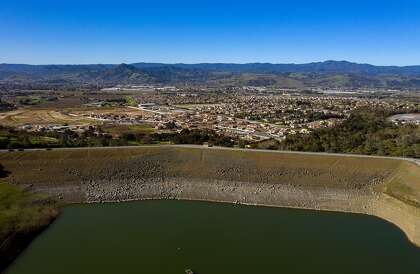
https://www.sfchronicle.com/opinion/editorials/article/Editorial-A-warning-for-Bay-Area-dams-15087415.php San Francisco Bay Area DAMS a Warning   An aerial view of the dam and at homes below it at Anderson Lake Reservoir on Tuesday, Feb. 25, 2020 in Morgan Hill, Calif. Editorial: A warning for Bay Area dams 2/27/2020 An aerial view of the dam and at homes below it at Anderson Lake Reservoir on Tuesday, Feb. 25, 2020 in Morgan Hill, Calif. Life in California depends on the dams and reservoirs that provide water for homes, farms, recreation, energy and, not least, safety. That last function should be getting serious consideration toward providing overdue answers about emergency preparedness. The more than 1,200 earth and cement structures that stand astride rivers and canyons across the state look solid enough, but many were built before engineers fully understood the threat of nearby seismic faults. Compounding the danger, a large number of decades-old dams are operating without updated policies on emergency notification of communities and businesses that have developed downriver since they were built. This general worry has become specific in the case of one Bay Area dam. Federal regulators want the Anderson Reservoir in Santa Clara County drained dry beginning this fall out of concern that the Calaveras Fault could unleash a disastrous jolt to the dam above Morgan Hill. Valley Water, the dam’s operator, disagrees, arguing that the lake is low enough now and that more releases could harm part of the facility. At stake is a needed water supply for the booming Silicon Valley and the economic health of the region. This standoff needs to be resolved. There are years-away plans to rebuild the dam, but federal regulators are in no mood to wait. Their order affects the county’s largest reservoir, though there appears to be enough supply to ward off major repercussions for water users. Chronicle Editorial Board The dam’s condition highlights another concern: If there is an emergency, dams should have quick-response plans to alert homes and businesses downriver. Three years ago, the Oroville Dam, the nation’s tallest, experienced a near disaster when an aging spillway crumbled, threatening the structure and forcing the evacuation of some 180,000 people downstream. The same winter’s heavy rains caused a spillover of the Anderson Reservoir that flooded neighborhoods in San Jose with little advance warning. The Bay Area needs better preparation for such dangers. A Chronicle report Wednesday showed at least 47 of 145 dams in the region don’t have updated plans to notify authorities and downriver communities in an emergency. The state requires such plans and should make a concerted effort to ensure that they are in place. This region is riddled with active fault lines that could precipitate a disaster. As the vagaries of climate change unfold, dams will be tested as never before. Droughts will alternate with heavy storm seasons, making water storage and flood control vital. In Santa Clara County’s case, a dry reservoir could mean taking more water from the federal and state water systems already facing competing demands from farmers and environmentalists. Dam safety is a crucial part of California water policy. It shouldn’t be neglected, especially when it comes to alerting the public if trouble looms. This commentary is from The Chronicle’s editorial board. We invite you to express your views in a letter to the editor. Please submit your letter via our online form: SFChronicle.com/letters.

The IMF and the World Bank: How Do They Differ?

https://www.imf.org/external/pubs/ft/exrp/differ/differ.htm

The IMF and the World Bank: How Do They Differ?

Known collectively as the Bretton Woods Institutions after the remote village in New Hampshire, U.S.A., where they were founded by the delegates of 44 nations in July 1944, the Bank and the IMF are twin intergovernmental pillars supporting the structure of the world’s economic and financial order. That there are two pillars rather than one is no accident. The international community was consciously trying to establish a division of labor in setting up the two agencies. Those who deal professionally with the IMF and Bank find them categorically distinct. To the rest of the world, the niceties of the division of labor are even more mysterious than are the activities of the two institutions.


Read more “The IMF and the World Bank: How Do They Differ?”

ALERT: Denmark’s new government raises climate change to highest priority

Denmark’s new government raises climate change to highest priority

JUNE 26, 2019

Denmark’s new government raises climate change to highest priority

In a deal with other left parties, the Social Democrats agreed to raise the country’s climate targets and place the green transition at the heart of policy


Read more “ALERT: Denmark’s new government raises climate change to highest priority”

World Bank and the Stern Review: The Economics of Climate Change – Brown University

World Bank and the Stern Review: The Economics of 
 
Climate Change – Brown University
 
 
Please read “all” the excerpts we have provided 
 
below:
 
Our actions over the coming few decades could create risks of major disruption to economic and social activity, later in this century and in the next, on a scale similar to those associated with the great wars and the economic depression of the first half of the 20th century. And it will be difficult or impossible to reverse these changes.

Read more “World Bank and the Stern Review: The Economics of Climate Change – Brown University”

Dams Place 39 US Reactors in Line of Fire Says Nuclear Expert – Fukushima-Style Scenarios Possible (Pt. 6) – EnviroNews | The Environmental News Specialists

Dams Place 39 US Reactors in Line of Fire Says Nuclear Expert — Fukushima-Style Scenarios Possible (Pt. 6)

Dams Place 39 US Reactors in Line of Fire Says Nuclear Expert — Fukushima-Style Scenarios Possible (Pt. 6)

(EnviroNews DC News Bureau) — Editor’s Note: The following news piece represents the sixth in a 15-part mini-series titled, Nuclear Power in Our World Today, featuring nuclear authority, engineer and whistleblower Arnie Gundersen. The EnviroNews USA special encompasses a wide span of topics, ranging from Manhattan-era madness to the continuously-unfolding crisis on the ground at Fukushima Daiichi in eastern Japan. The transcript is as follows:

Arnie Gundersen: When Maggie and I were walking one day in February [a month] before the [Fukushima] accident, she said to me, “Where is the next accident going to be?” And I said, “I don’t know where, but I know it’s going to be in a Mark 1 reactor.” And, I’m not alone. It’s not like I was clairvoyant. The Nuclear Regulatory Commission had a report that they published in 1982, and they said there was an 85 percent chance, if there was a meltdown in a Mark 1 reactor, that the containment would explode. The writing was on the wall.

Emerson Urry: How many of these things are still out there in operation today?

Gundersen: In the U.S. all 23 continue to run.

Josh Cunnings (Narrator): Welcome to the EnviroNews USA news desk. I’m Josh Cunnings. Tonight, we bring you the sixth of 15 short films in our educational series, Nuclear Power in Our World Today, featuring esteemed nuclear expert and whistleblower Arnie Gundersen.

To the people whose homes and lives were taken from them by this almighty tidal wave, it made no difference if the water came from a bursting dam or levee, an overflowing river, or from the sea. It probably just doesn’t make much difference at the point where either your home, or yourself or your children, are floating away to their demise. Likewise, it will make absolutely no difference where the waters come from if, or when, they end up submerging a nuclear power plant again in the future.

The lurking and looming danger of another flood overtaking a nuclear reactor is the topic of conversation in this episode. To delve more deeply into that issue, here’s nuclear expert and former power plant operator Arnie Gundersen – again with EnviroNews USA Editor-in-Chief Emerson Urry. Take a listen.

Urry: And on that topic of the Mark 1, and some of the dangers there, nuclear power is more prevalent on the East Coast in this country than the western side – could we have… what if we had one of these big tsunamis like happened to Indonesia, and it happened on the East Coast? Do we have multiple nuclear power plants in the line of fire of such an event, and what could happen in a situation like that? Is that something that is ever even talked about, or that they plan for, or think about at all?

Gundersen: Well, it doesn’t have to be a tsunami to cause the same kind of accident we had at Fukushima Daiichi. There’s a power plant called the Oconee — and it’s just three of them, and they are downstream from a huge dam — and if the dam fails, you’ve got an inland tsunami. There was a plant out in… the Fort Calhoun plant near Omaha – the pictures from about three years ago show it completely surrounded because the river flooded. There were six upstream dams and if one of them had failed, they all would have cascaded, and we would have had not a nuclear power plant, but a nuclear submarine. So, these problems don’t require a sea-wave to come in and knock them out. There’s 39 plants at risk of upstream dam failures. That’s just one example of [how] the NRC has, not only hidden that report, but when two people on the NRC brought that report out anyway, those two people were investigated by the cops. It doesn’t pay to be honest with the Nuclear Regulatory Commission.

Urry: Have we been pretty lucky so far?

Gundersen: Yes. We’ve been extraordinarily lucky. [The] Union of Concerned Scientists writes a report every year about all the near misses, and they have no trouble filling a couple hundred pages, every year, of near misses.

Cunnings: Well, there you have it. These risks are there and they are all too real. The question is: how many catastrophic nuclear disasters does humanity need to get the point? And how severe do these catastrophes need to be for humans to understand?

It’s important to remember that because Mikhail Gorbachev made the incredibly difficult decision to throw about 600,000 men directly at Chernobyl’s ground zero – and due to the incredibly heroic and deadly work performed by those brave young men and soldiers, only about four percent of what could have been released from Chernobyl, was actually released – and even that wreaked untold devastation.

How many nuclear disasters must the world undergo, and what must the severity be, in order for humanity to change its ways?

Extremely unsafe situations – like reactors downhill from dams, represent only one example of the myriad threats facing nuclear power plants. Nevertheless, old Mark 1s, and many other dangerously located reactors, remain in operation today – despite countless safety concerns.

One thing that’s almost certain is if you play with fire long enough you will get burned. Sadly, humans often suffer a form of collective amnesia regarding the severity of these disasters. Hopefully, over time, and with more good reporting and educational programming, that will change.

Join us tomorrow when we ask the question: what is America’s worst-ever nuclear disaster? Think you already know what it is? The answer to that question may very well surprise you.

From the EnviroNews USA news desk, this is John Cunnings. Thank you for joining us, and good night.

Excerpt from History Channel Video on Idaho’s Teton Dam Failure

Narrator: Another warning sign: high-pressure springs appeared in the earth thousands of feet downstream from the dam. On the dam face itself the wet spots became leaks. On the morning of June 5, 1976, more leaks developed. A government photographer took this series of pictures as the wet spots turned into small holes; then larger holes in the face of the dam. The dam was collapsing before his eyes. Then suddenly, the 500-yard-thick earthen wall collapsed like a sand castle under a wave. Torrent washed away everything in 300 square miles. 80 billion gallons of water totally destroyed two towns and killed 11 people. The failure of the Teton Dam led to a national review of federal rules regarding dam construction and inspection.

WATCH OTHER EPISODES FROM THE ENVIRONEWS SERIES NUCLEAR POWER IN OUR WORLD TODAY

Opening Remarks Bilderberg Meeting 2014 – by William Van Duy

https://www.bibliotecapleyades.net/sociopolitica/esp_sociopol_bilderberg_54.htm

Ladies and gentlemen,


Let me welcome you at the 60th edition of the Bilderberg meeting here in Copenhagen.


Since the creation of the Bilderberg meeting back in 1954,

…decided to organize an event to unite different entities from industry, politics and culture.

After the fourth Meeting back in 1958, the Bilderberg members put together the conditions of the Treaty of Rome. It was finally signed and the European Community was born with 6 States members.

Today the European Community contents 28 countries. And today the Bilderbergers advise 134 states members.


Today, my speech will be officially published by our new ‘enemy’: the Media.


Bilderberg isn’t a secret society, never was. Perhaps in the eyes of the population, but what we did is we kept our topics and decision to ourselves. We are not an evil. I do not have an all-seeing eye. My ancestors only made sure the Eye is on the [U.S.] dollar bill.

Bilderberg is no conspiracy, but people and conspiracists with their infantile fantasies see it as such. None of you, and I don’t care how powerful you are, sit around the table in a dark room, holding hands, staring at a crystal ball, planning the world’s future.

The exuberant myth created by conspiracy theorists, journalists, and media moguls has been fabricated about the image of the Bilderberg. But are they really the cause of our consequences? Didn’t we involve ourselves into this luxurious secretive, mystical image?

Going back in time, I am today in conversation with a certain controversial researcher who studied the Illuminati for more than 2 decades [Fritz Springmeier]. I respect this gentleman for his courage and vision.


I want to change history. I do believe that mankind has a right to their future.

The population is frustrated, manipulated, and demoralized by their own leaders. They live in their own Cartesian fantasies with the hope God will sent a messiah to save their soul! God has other plans with humanity. He creates the balance between good and evil.

Time changes: and I am glad to feel those changes. I feel a general awareness and singularities of awaken ones… People are beginning to ask me the good questions. Their main question is “what is right?”. It’s a phenomenon of response and reaction to an overly felt perception that the entire world is doomed to catastrophe, poverty, injustice and misery.

What makes the Bilderberg so strong?


It is because of its perseverance. Members are coming and leaving, guests come and go but the system grows stronger and stronger. No president, no king, no dictator, nor prime minister dares to criticize my name nor the Bilderbergers, and they know they are the puppets of the powerful Illuminati working from behind the scenes.

The general economy is collapsing. People are grasped by something they don’t always understand. But, it forces them to act in a blind way for their own interest.

That’s what they are doing in major countries and certainly in the United States: the anthropic country!

Hillary Clinton told me yesterday it’s like a streaming movement came upon America and washed its pride away. As people realize that their existence is threatened, they pray to God, blame their government, the Bilderbergers and the King of Satan called the Illuminati.

At the recent Council on Foreign Relations speech in Brussels a few days ago, I warned that a “global population awareness,” was threatening a revolution towards their governments.


You come from very different ideological, economic, cultural and political backgrounds. What unites us is that we are all determined to find the solution for humanity and its humankind.

And those who work for their own greediness, success and hunger for fame, who have sold their nations like,

…are traitors. Not only traitors of their people and their nations, but for humanity as a whole entity.

The subject of this Bilderberg meeting is the One World Government


Seven years ago the economy of Europe almost collapsed. It wasn’t because of the Europe’s weak economy. It came right to us from the United States of America with their unstable banking system.

The bursting of the U.S. housing bubbles which peaked in 2006 caused the values of securities tied to U.S. real estate pricing to plummet, damaging financial institutions globally without mentioning the national debts.

  • World economy crisis because of American housing?
  • Because of their gluttony?
  • Does the rest of the world economy need to rely on US economy?

Another key is implemented in the United States: a universal principle of welfare on which the United States is based.

But welfare does not mean a useless bum sitting on the couch, eating a pizza, slobbering the beer over himself, watching television, while he/she is waiting for an unemployment check to arrive.

Please ask an average man the intention of the existence of humans, or of government? Would his/her answer be to provide for the general welfare of future generations of mankind? I don’t think so.

People want a Nation, an Empire. Educate the people that is what they want: globalization.

People believe that in order to have an Empire, you need money. But money is not a result of wealth. The economy is not based on money but on production and innovation. Money does not make the world go around. Money has no value. When families are harvesting their own vegetables and fruits in their garden they have more value and real money.

Human Mind Control. Human Minds affect the planet. This is how it is measured. It means immortality for the Soul of humankind. We are able to enjoy the universal principles. It allows people to innovate, to believe, and to harmonize the relation between man and nature.

Human are destroying their own life on purpose by their hunger for higher living standards. They are digging their own grave pushed by their own debts. If humanity doesn’t change its attitude, 35% of the population will be wiped out. They destroy their own creative power with no reason.

Population blamed on the depression. But the 2008 depression was not an event that wiped out the world capitalists. It was meant to make the world population aware of their greediness and laziness in their life, to let them face the spectacle of poverty. They blame the banks, the governments, and all of us.

Let’s give them what they want…

Why don’t we give them the right of ruling the nature of economy, social welfare, the game of the wars and the innovation of the future…

  • The Greeks are blowing the European system with their unpayable debts.
  • The French are voting the Front National to rescue the French patriotism.
  • The Italians are Italians.
  • I do not ask you to be too emotional, we’re not Spanish.
  • I even don’t want to go the direction of Eastern Europe, Russia nor Asia.
  • And then comes Brussels and the European Community.

Let’s fire them all…

Those horrible useless people, sitting in nice conference room, kick out Herman Van Rompuy (sorry Herman) but he is useless. Brussels the evil city of the world ruled by the Illuminati.


Washington, those wet rags… fighting between dumb Republicans with their belief in guns and gospels against the stupid Democrats with their socialism ideology following the rules of Lenin.

Ask a Republican redneck the difference between socialism and fascism or the democrats about guns and gospel…

  • Does the government even know about the needs of its citizens?
  • Do they know about the middle class and its poverty?
  • Are they aware about the lack of education of its citizens?
  • The truth behind the abomination of the health system?

We need to resolve the American problem for its population.

With a stronger America we will be able to influence the world economy in the right direction for humanitarian purposes. We will have a better understanding in the Asian Market. Guns, gospels, and socialism will not help them. Each single American has to do it by him/herself.

Population will rule perfectly the world for the greater good of Humanity!

I am talking about morality, and not scientific nor economic problems.

  • Do people think about their future in 10 years?
  • What kind of future will they have in 5 decades?
  • Do they have a right to dream?
  • Who are the bad guys here?

I told myself all humanity must be saved. But is it really possible?

The brutality in humanity only waits for the courageous and the sane human to perfect the concept of nations. I believe in the fraternity of Nations. But at the moment governments are ruling by their own personal political agendas manipulated by the interest of the industries either to solve the problems in their countries.

It is the duty of the Illuminati to control every movement within any government, to provide security to its population, therefore we create the rules, we decide about nations policy.

The Bilderberg needs to guide the economic factors in the right direction and build trust within the population!

I refuse any secrecy of decisions made by us. Why should we continue to rule the system behind closed doors? Why wouldn’t we face the population with their own mirror and tell them: Hey! Wake up…


Bilderberg Meeting is tool of the Illuminati. It runs because of the Illuminati. Bilderberg is the strongest and most powerful association, the perfect concept for sound economic security, by keeping the world order in shape, and the initiator of mankind in the age of reason.

I want this Bilderberg to be the first meeting in a new direction providing ‘openness’ to the population in regard and respect for the future generations.

Next year positive results will show to the world that we aren’t evil, but we help humanity because humanity isn’t able to rescue itself.

Positive Diversity is the only hallmark of progress with an insurance policy for the population.

TARGETED: What is going on with abusive psychiatry today?


 What is going on with abusive psychiatry today?TRAPPED BY CORRUPT PSYCHIATRY!January 2020  From: Angela Budd Hello my name is Angela, I am a 49 year old christian woman located in The Miramaci New Brunswick canada area, how ever i was residing in British columbia for quite a number of years until May 2017, I thought that i would explain my story that has been going on now for nearly 17 years, I want to see ifDeborah taverse can help me to stop the crime that has been happening to me or at least get some body who can and will help me! My story goes back to the year of 2003 when i was residing in the British columbia surrey area of Canada! I was in a new area of Surrey B,C. and i was going to join a new church group, When all of a sudden i was unlawfully detained by a very corrupt governmental agency known as Frasier Health Authority Located at 11th Floor Station Tower 9Gateway station) 13401- 108th Ave Surrey B.C CANADA V3T- 5T3 to make a very long story short i was held against my will by psyciatry for my christian religouse beliefs I was kidnapped by FRasier health authority psyciatry and they will not let me go to make matters even worse i must tell you that i was and have been being very badly abused, to torturouse states and lied about ( character assination) is what you would call it and psyciatry made up untrue stories about me to be able to unlawfully and unfairly detain me further they lied about me having a mental illness and said that i had schizophrenia when i do not have any mental problems at all as well as my behaviour is perfectly calm and loving and very normal! and my church friends that know me will tell people that, i was held and i was also surgically raped and injured purposly by the OBGYN that FRasier health authority forced me to go and see! They have injured my uterus so that i can not hold a pregnancy in or get a baby out of me without a doctors help! this is surgical rape and an attempt to sterilize me against my will! i was made impoverished as they got and had complete control over me ( my person) they controlled my bank accounts my money and they also sat on my name date of birth as well as place of birth and my social insurance number they were moving me around against my will ( which is legal definition for kidnapp) and they were interfering with my employment as well as employers i got into college a few years back as i am very intelligent i got up the funding myself and i did the work and i made better grades i was told than the people already in college there i was doing very well in college i had make up on new clothes as well as new books and i was making good grades and not missing any classes and when the psyciatrist who liked to control everything about me found out that i had funding and he saw the new clothes and books he was not happy for me at all instead he purposly had my college funding as well as my college education shut down on me! ( PLEASE. NOTE: that when i was in B.C i am an intelligent woman and psyciatry did not like that very much as they were controlling everything about me they (FRASIER HEALTH AUTHORITY) had kept me impoverished, abused, locked up in cold cruel cells and when i was in public i was so impoverished that i could not even afford to buy myself a small coffee at the local mcdonald’s restauraunt! I made several complaints to the Surrey R.C.M.P. about FRASIER HEALTH AUTHORITY and the R.C.M.P. told me that they would get back to me however they acted like they had not received any reports from me and they did not step in to protect me from the psyciatric abuse i was being transported to the Surrey memorial hospital located at 96 AVE. and KING GEORGE HIGWAY IN THE SURREY B.C. AREA FRASIER HEALTH AUTHORITY IN SURREY B.C are a very corrupt governmental agency that should be closed down i was so badly abused by them that in the summer of 2016 i was litterally on my death bed i was vommiting large quantities of bright red blood as well as i was told that my kidney’s were shutting down and that the doctor said that i might need dialysis i was very sick because of psyciatry was poisioning me by over dosing me with several kinds of very harmful dangerouse psyciatric drugs PLEASE ALSO NOTE: that they were forcing the drugs into me by injections against my will they even were forcing me to see a doctor a general practioner every week to every 2 weeks when i was first detained by them i was not sick then and i was being forced against my will to go to these so called check ups were the doctor always was checking me for christian pregnancies and she would every week try to examine my vaginal area as well as give me full physicals as well as breast exams and asking me very personal questions which was none of her buisness like what boys i was interested in in the community etc! PLEASE NOTE: that i am a full grown intelligent woman that know when i need to go see a doctor and i am quite capable of choosing my own family doctor and also this was medicalized rapes as i do not need vaginal exams nor full physicals nor breast exams every 1 to 2 weeks!FRASIER HEALTH AUTHORITY was also coming into my home againstmy will and they were playing a very unfair, scarry, abusive, corrupt governmental system against me ! PLEASE ALSO NOTE: that they did and have been doing all this to me and i have not even been to court once they just pulled me out of a church in canada under false pretensis of the mental health act and raped tortured abused me and held me controlling everything about me against my will PLEASE NOTE: that i have not commited any crimes nor have i broken any laws THE CRIMES ARE BEING COMMITED BY PSYCIATRY AND THEY ARE DETAINING OTHER INNOCENT PEOPLE AS WELL AND DRUGGING THEM AND TORTORING THEM ALL BECAUSE OF OUR RELIGOUSE OR POLITICAL BELIEFS! please see on internet cchr international videos about psyciatric abuse one video is called CCHR INTERNATIONAL VIDEO :WHAT WE BELIEVE” also see CCHR INTERNATIONAL VIDEOS ON PSYCIATRIC ABUSE AND CRIMES i have made psyciatric abuse reports with CCHR INTERNATIONAL but all they can do is document the abuse i need urgent help to get a lawyer in my area who can practice this type of law in the new brunswick area as well as in the BRITISH COLUMBIA area also in MAY 2017 I had taken all the persecution, medicalized rapes,torture and the unfair detainment i had taken all i could take from FRASier health authority and i walked out of the Surrey BRitish columbia area and for the first time in my life found myself having to hitch hike my way back to were i was originally from miramichi new brunswick area, I only hitch hiked because FRSIER HEALTH AUTHORITY HAD ME COMPLETELY IMPOVERISED AND THEY WERE AND STILL ARE VICTIMIZING ME THEY HAD THE R.C.M.P. FOLLOW MY ACROSS THE COUNTRY AND JUST WHEN I MADE IT BACK TO MY HOME TOWN THE LOCAL R.C.M.P. TREATED ME LIKE A CRIMINAL AND GRABBED ME AND I SAID TO THE VERY CORRUPT OFFICER : I HAVE NOT COMMITED ANY CRIMES NOR AM I A DANGER TO OTHER”S OR MYSELF WHY ARE YOU TREATING ME LIKE A CRIMINAL LIKE I DID SOMRTHING WRONG WHEN IT IS YOU WHO ARE IN THE WRONG?” SHE GAVE ME NO ANSWER BUT BROUGHT ME INTO PSYCIATRY AGAIN WERE I AM STILL BEING UNFAIRLY DETAINED AGINST MY WILL AND THEY PSYCIATRY IS LYING ABOUT ME AGAIN AS WELL AS ABUSING ME AGAIN AND THEY ARE INJECTING ME LIKE A LAB RAT OR GUINE PIG IT SEEMS LIKE THEY ARE TESTING DRUGS ON THE PUBLIC AGAINST OUR WILL AND I HAVE BEEN HAVING MY HUMAN RIGHTS ABUSED AS WELL AS MY WOMEN;S RIGHTS ABUSED AS WELL AS MY RIGHTS TO FREEDOM OF THOUGHT AND RELIGOUSE RIGHTS AND FREEDOMS ABUSED I HAVE BEEN BEING HELD AND ABUSED AND THREATENED BY PSYCIATRY AND I HAVE DONE ABSOLUTLY NOTHING WRONG THIS IS CHRISTIAN CRUELTY AND PERSECUTION PLEASE SEE THE LEGAL DEFINITON OF PERSECUTION IT IS SOM GROUP TREATING AN INDIVIDUAL OR ANOTHER GROUP OF PEOPLE KEEPING THEM IN FEAR FOR THERE LIVES AS WELL AS IMPRISSONMENT UNFAIR UNLAWFUL DETAINMENT USUALLY BECAUSE OF RELIGOUSE BELIEFS AS WELL AS KEEPING THAT INDIVIDUAL IN PAIN FEAR AND TORTURE! I HAVE BEEN BEING HELD NOW AGAINST MY WILL AND ABUSED GOING NOW ON SEVENTEEN YEARS PLEASE NOTE” THAT I HAVE 1 SON WHO IS NOW 28 YEARS OF AGE AND I HAVE ALSO BEEN SEPERATED FROM HIM AND I HAVEN’T SEEN HIM IN 3 YEARS NOW AND I LOVE HIM AND MISS HIM VERY MUCH! SO CAN YOU PLEASE HELP FREE ME FROM MY NIGHTMARE?PSYCIATRY HAS LIED ABOUT ME ABUSED AND TORTURED ME MAIMED ME INJURED ME AS WELL AS FINANCIALLY IMPOVERISHED ME I HAVE NOT COMMITED ANY CRIMES NOR HAVE I DONE ANYTHING WRONG TO DESERVE THIS ABUSE DETAINMENT SEPERATION FROM MY CHILD NOR AM I A DANGER TO ANY ONE HOWEVER THE CORRUPT GOVERNMENTAL AGENCIES WILL NOT LET ME GO NOR LEAVE ME ALONE I WAS UNLAWFULLY DETAINED UNLAWFULLY LABELLED AND UNLAWFULLY IMPRISONED FOR THE LAST 17 YEARS AND I HAVE NOT BEEN ABLE TO GO SEE A JUDGE HAVE A COURT HEARING OR A TRIAL APPARENTLY PSYCIATRY TODAY IS ALLOWED TO UNFAIRLY DETAIN INNOCENT PEOPLE WITHOUT THEM BEING ABLE TO HAVE A FAIR DUE LEGAL PROCESS WHEN SOMBODY IS MAKING UP STORIES ABOUT YOU THAT ARE UNTRUE AND TAKING AWAY YOUR FREEDOM AND CALLING YOU MENTALLY ILL SO THEY CAN HAVE POWER AND CONTROL OVER YOU AND HURT YOU BUT I THINK THAT I HAVE A RIGHT AS A CANADIAN CITIZEN TO GET A LAWYER AND TO GO INTO COURT AND HAVE A TRIAL AND EXPLAIN MY SIDE OF THE STORY! SORRY THAT THIS EMAIL IS SO LONG BUT MY QUESTION TO DEBORAH TAVERS IS CAN YOU HELP ME DEBORAH HELP ME TO GET A LAWYER AS I HAVE BEEN TRYING AND WORKING AROUND THE CLOCK TO GET LEGAL REPRESENTATION HOWEVER I SEEM TO BE STUCK WITHIN A VERY CORRUPT GOVERNMENTAL SYSTEM ONE IN WHICH THE POLICE DO NOT PROTECT ME FROM THESE PSYCIATRIC CRIMINALS I WAS THREATENED BY THE PSYCIATRIST WHO IS NOW ABUSING ME IN THE MIRAMICHI NEW BRUNSWICK AREA HIS NAME IS DR. SANJAY SIDDHARTHA OF HORIZON HEALTH IN THE MIRAMICHI NEW BRUNSWICK HOSPITAL PSYCIATRY UNIT LOCATED AT 500 WATER STREET MIRAMICHI NEW BRUNSWICK! CAN YOU PLEASE TRY TO GET ME A LAWYER I AM HAVING A DIFFICULT TIME GETTING A LAWYER AS PSYCIATRY HAS KICKED ME UP ON DISSABILITY AND HAS COMPLETLY IMPOVRISHED ME AS A MEANS TO CONTROL ME! THEY (PSYCIATRY) IS DOING THIS TO ME TO MAKE MONEY THEY DON’T CARE ABOUT PEOPLE IT IS LIKE A HITLER MOVEMENT ALL OVER AGAIN! PLEASE DO NOT SEND THE CANADIAN R.C.M.P AS THEY HA E BEEN BEHAVING VERY CORRUPTLY AGAINST ME! PLEASE LET ME KNOW SEND ME BACK AN EMAIL EITHR WAY TO LET ME KNOW IF YOU CAN HELP ME TO GET A LAWYER OR IF YOU CAN HELP ME IN SOME OTHER WAY MY EMAIL ADDRESS IS angelabudd1@gmail.com thank you very much and god bless please help to stop the crimes being done against me and to set an innocent person free and to stop this psyciatric abuse it’s torture i would also like to see my only son whom i have not seen for 3 years now because i can not go back to the B.c. atea were my son lives because FRASIER HEALTH AUTHORITY WILL BEGIN TO TORTURE AND CONTROL EVERYTHING ABOUT ME AGAIN! thanks sincerly Angela TRAPPED BY CORRUPT PSYCHIATRY!

Harvesting the “Blood” of America’s Poor . . .

Harvesting the “Blood” of America’s Poora plasma market of dehumanization
No lack of human “victims” willing to be treated like animals in farms, in exchange for a few dollars. It was an assembly line to extract liquid gold from human mines.
“It’s absolutely deplorable to leverage literal blood money from people who have so few options.”
Donors are publicly weighed to make sure they are heavy enough. Obese people are worth more to the bloodthirsty companies as they can safely extract more plasma from them each session (while paying out the same compensation).

IN AMERICA’S wretched economy, where around 130 million Americans admit an inability to pay for basic needs like food, housing or healthcare, buying and selling blood is of the few booming industries America has left.One study found that the majority of donors in Cleveland generate more than a third of their income from “donating” blood. Almost half of America is broke, and 58 percent of the country is living paycheck to paycheck, with savings of less than $1000. 37 million Americans go to bed hungry, including one-sixth of New Yorkers and almost half of South Bronx residents.And over half a million sleep on the streets on any given night, with many millions more in vehicles or relying on friends or family. It is in this context that millions in the red have turned to selling blood to make ends meet. In a very real sense then, these corporations are harvesting the blood of the poor, literally sucking the life out of them.Donated blood is crucial in treating medical conditions such as anemia and cancer and is commonly required to perform surgeries.

The majority of the plasma goes to wealthy European countries; Germany, for example, buys 15 percent of all U.S. blood exports. China and Japan are also key customers

blood plamsa poor feature photo

AMERICAN DYSTOPIA

Harvesting the Blood of America’s Poor: The Latest Stage of Capitalism

Blood has become big business in the United States and there is no shortage of corporations ready to exploit America’s most vulnerable populations in order to get a piece of the pie.

by Alan Macleod

December 03rd, 2019

By Alan Macleod 

For much of the world, donating blood is purely an act of solidarity; a civic duty that the healthy perform to aid others in need. The idea of being paid for such an action would be considered bizarre. But in the United States, it is big business. Indeed, in today’s wretched economy, where around 130 million Americans admit an inability to pay for basic needs like food, housing or healthcare, buying and selling blood is of the few booming industries America has left. 

The number of collection centers in the United States has more than doubled since 2005 and blood now makes up well over 2 percent of total U.S. exports by value. To put that in perspective, Americans’ blood is now worth more than all exported corn or soy products that cover vast areas of the country’s heartland. The U.S. supplies fully 70 percent of the world’s plasma, mainly because most other countries have banned the practice on ethical and medical grounds. Exports increased by over 13 percent,to $28.6 billion, between 2016 and 2017, and the plasma market is projected to “grow radiantly,”according to one industry report. The majoritygoes to wealthy European countries; Germany, for example, buys 15 percent of all U.S. blood exports. China and Japan are also key customers.

It is primarily the plasma– a golden liquid that transports proteins and red and white blood cells around the body– that makes it so sought after. Donated blood is crucial in treating medical conditions such as anemia and cancer and is commonly required to perform surgeries. Pregnant women also frequently need transfusions to treat blood loss during childbirth. Like all maturing industries, a few enormous bloodthirsty companies, such as Grifols and CSL, have come to dominate the American market.


But in order to generate such enormous profits, these vampiric corporations consciously target the poorest and most desperate Americans. One study found that the majority of donors in Cleveland generate more than a third of their income from “donating” blood. The money they receive, notes Professor Kathryn Edin of Princeton University, is literally “the lifeblood of the $2 a day poor.” Professor H. Luke Schaefer of the University of Michigan, Edin’s co-author of $2 a Day: Living on Almost Nothing in America, told MintPress News:

The massive increase in blood plasma sales is a result of an inadequate and in many places non-existent cash safety net, combined with an unstable labor market. Our experience is people need the money, that’s the primary reason people show up at plasma centers.”

Almost half of America is broke, and 58 percent of the country is living paycheck to paycheck, with savings of less than $1000. 37 million Americans go to bed hungry, including one-sixthof New Yorkers and almost half of South Bronx residents. And over half a million sleep on the streets on any given night, with many millions more in vehicles or relying on friends or family. It is in this context that millions in the red have turned to selling blood to make ends meet. In a very real sense then, these corporations are harvesting the blood of the poor, literally sucking the life out of them.

I see we’ve moved on to the “harvesting the blood of the poor” stage of late capitalism

View image on Twitter

52.3K9:17 PM – Jan 13, 2017Twitter Ads info and privacy34.7K people are talking about this

MintPress News spoke to a number of Americans who consistently donated plasma. Some of them did not want to be fully identified. But none were under any illusions about the system and how they were being exploited.

“The centers are never in a good part of town, always somewhere they can get a never ending supply of poor people desperate for that hundred bucks a week,” noted Andrew Watkins, who sold his blood in Pittsburgh, PA for around 18 months.

 The people who show up are a mix of disabled, working poor, homeless, single parents, and college students. With the exception of the college students who are looking for booze money, this is probably the easiest and most reliable income they have. Your job may fire you at any time when you’re on this level of society, but you always have blood. And selling your blood doesn’t count as a job or income when it comes to determining disability benefits, food stamps, or unemployment eligibility so it’s a source of money for the people who have absolutely nothing else.”

Rachel from Wisconsin, who donated hundreds of times over a seven-year period, also commented on the obvious socio-economic makeup of donors.

We were poor, all of us in there you could easily tell that we were on the lower ends of the income bracket. They incentivize you with bonuses and the more you donate in a month the more you’ll get paid, recruiting friends bonuses, holiday bonuses, etc.”

Keita Currier from Washington, D.C., noted how she and her husband had little choice but to continue visiting clinics in Maryland for years but resented their payment methods.

 They’re predatory, the price set for your plasma is based on a whim. For example, one place I donated the first five times you get $75, then you get 20, 20, 30, 50, 25. It’s random, it doesn’t matter, but they know you are desperate and if you don’t do your $30 donation you won’t get your 50 next time. Apparently, the plasma is worth something in the hundreds, so it is not surprising that you’re screwed over.”

Zombifying America’s poor

Respondents all agreed that they were indeed being exploited, but in more ways than one. Desperate Americans are allowed to donate twice per week (104 times per year). But losing that much plasma could have serious health consequences, most of which have not been studied Professor Schaefer warns, stressing that more research is necessary. Around 70 percent of donors experience health complications. Donors have a lower protein count in their blood, putting them at greater risk of infections and liver and kidney disorders. Many regulars suffer from near-permanent fatigue and are borderline anemic. All this for an average of $30 per visit. Rachel described the terrible Catch-22 many of the working poor find themselves in:

 I got turned away twice – once for being too dehydrated and once for being anemic. Being poor created a shitty paradox where I couldn’t eat, and because I couldn’t eat my iron levels weren’t high enough to allow me to donate. That was a week of a pay cut, money I desperately needed for rent and bills and meds.”

A common method of cheating in endurance sports is to inject extra blood into your system before a race, giving you a huge performance boost. But extracting it has the opposite effect, making you sluggish and tired for days. Thus, this debilitating practice is zombifying America’s poor.

Plasma donation

A Maryland plasma center is shown in a promotional image for CSL Plasma, one of the largest corporations dominating the market

The process of giving blood is not a pleasurable one. Currier noted that after constantly donating, “the bruising gets terrible…Sometimes they can’t find the vain ‘n’ shit or they insert it wrong and they have to adjust the needle underneath your skin” she said, claiming that just thinking about it freaks her out, and revealed that her husband had to temporarily stop donating as his bosses thought he was on heroin due to the track marks on his arms.

Watkins agreed. “You could always tell how long someone had been doing the job by that needle,” he recalls. “Once they’d been there a year or so, they’d have stabbed literally thousands of people and could just tap your elbow once and slide the needle into the vein with no problems. New guys would miss the vein, punch through the vein, or try to hunt for it with the needle tip, which would leave terrible bruises.”

There is also little thought for the comfort of the patients. As Watkins explained, the thermostats are always turned down to around 50-60ºF for the plasma’s sake. Once the amber-colored plasma has been extracted, your cooled blood is re-injected in a painful process that feels as if ice is being inserted into the body. “Combined with the already cold air temperatures, this was maddening,” he notes.

Thus, America’s zombie poor are left almost permanently mentally drained like heroin addicts, and with similarly bruised and punctured arms, except they are being paid for the inconvenience. But perhaps the worst thing about the experience, according to those interviewed, is the dehumanization of the process. 

Donors are publicly weighed to make sure they are heavy enough. Obese people are worth more to the bloodthirsty companies as they can safely extract more plasma from them each session (while paying out the same compensation). “They definitely turn you into a product in a very literal sense,” Watkins says; “It’s deeply exploitative and a symptom of just how far gone capitalism is.”

Many centers are enormous, with multiple rows of dozens of machines working in an attempt to appease the insatiable appetite of the vampiric corporation. And there is, according to Watkins, no lack of human “victims” willing to be treated like animals in battery farms, in exchange for a few dollars: “It was an assembly line to extract liquid gold from human mines,” he notes. 

Currier also highlighted the treatment of the staff and the cost-cutting measures of clinics in Maryland she visited would enact:

 Usually the places are hugely understaffed which means they frequently don’t change gloves, the people are overworked, and at the minimum you’re staying there for 2-3 hours which means you have to plan a whole day around this shit only to get 20 bucks in your pocket to make it through the next few days. It’s depressing, disheartening and frankly embarrassing to have to hustle like this. I feel like shit after I donate.”

Exploitation reaches new levels

But the exploitation of humans has reached new levels in clinics on the U.S.-Mexico border. Every week, thousands of Mexicans enter the U.S. on temporary visas to sell their blood to for-profit pharmaceutical corporations. The practice is banned on health grounds in Mexico but is completely legal north of the border. According to ProPublica, there are at least 43 blood donation centers along the border that prey primarily on Mexican nationals in a legally ambiguous practice.

According to a Swiss documentary on the subject, there are precious few checks on the cleanliness of the blood these companies accept, with some donors interviewed admitting they were drug addicts. But all is sacrificed in the pursuit of dazzling profits, something donors were well aware of. Rachel from Wisconsin admitted,

 I did it for the money, I think we all do it for the money, but it’s not really something you out and out say because there’s a veneer of “helping the sick” slathered over it. But I caught glimpses of what kind of industry it was on occasion through innocuous questioning. The amount of plasma drawn from one person per donation was worth upwards of $600, I never really got a clear answer on that.

Andrew from Pennsylvania agreed, noting wryly,

 I know my plasma was worth thousands of dollars per donation [to others], because I’ve seen what a hospital in my city charged a hemophiliac for platelets, so the pittance that they pay is ridiculous, but there is only one buyer making offers at the human level. If you’re poor and out of other options, you’ll take $40 however you can get it. Any port in a storm.”

Michael, a social worker from Georgia who sold his blood for extra cash, was deeply scornful of the entire situation. “I’ve known quite a number of people who rely on money made by selling plasma. A lot of times it’s to cover childcare or prescriptions or something along those lines,” he said. “It’s absolutely deplorable to leverage literal blood money from people who have so few options.”

Blood donation sign

A sign encouraging students to sell blood to fund their education. Twitter | @tjulrich

Big pharma is particularly interested in the blood of the young. One billboard campaign from Grifols intentionally targeted working-class students. “Need books? No worries. Donate Plasma” reads the headline. Teenager blood is in high demand in, of all places, Silicon Valley, where anti-aging technologies are the latest trend. One company, Ambrosia, charges $8,000 per treatment to aging tech executives, infusing them with the blood of the young, turning these individuals into bloodsuckers in more ways than one. Despite the fact that there is no clinical evidence that the practice has any beneficial effects, business is booming. One committed customer is PayPal co-founder turned Trump surrogate Peter Thiel, who is reportedly spending vast sums of money on funding anti-aging startups. Thiel claims that we have been conned by “the ideology of the inevitability of the death of every individual” and believes that his own immortality may be just around the corner, a notion that has deeply concerned academics and commentators alike.

The new and booming blood market is the perfect embodiment of the late capitalist dystopia modern America has become. The dehumanizing process of harvesting the blood of the poor to fund the quixotic immortality dreams of the super-wealthy turns the former into walking, living zombies and the latter into vampires, feasting on the blood of the young; a true American horror story worthy of Stephen King or H.P. Lovecraft. As Rachel from Wisconsin said:

It really is an industry where ‘squeezing blood from stones’ is about as literal as you can get.”