Disclosed herein is a newly isolated human coronavirus (SARS-CoV), the causative agent of severe acute respiratory syndrome (SARS). Also provided are the nucleic acid sequence of the SARS-CoV genome and the amino acid sequences of the SARS-CoV open reading frames, as well as methods of using these molecules to detect a SARS-CoV and detect infections therewith. Immune stimulatory compositions are also provided, along with methods of their use.
BLM and other similar groups are organized to bring in
the NWO Cyborg Police and more.
Cyborg warriors – that is the plan,
get others to do the killing or more specifically semi autonomous and
autonomous vehicles as an Israeli/Russian can operate that from Tel Aviv.
5G is central to the robots on the streets. When they get them over the next
3-5 years, we are done.
Also, they will get rid of the
clerks, the book keepers, and middle managers with A.I.
So the humans keeping your channel
up will be gone. It’s approaching fast and Javanka Kushner – Chabad – and
those in the New York deep state – and others, will usher in the age of
communitarianism 2028 in time for 2030.
Then remember the promised hordes and swarms of nano-bots, slaughter bots and drones.
Gov.
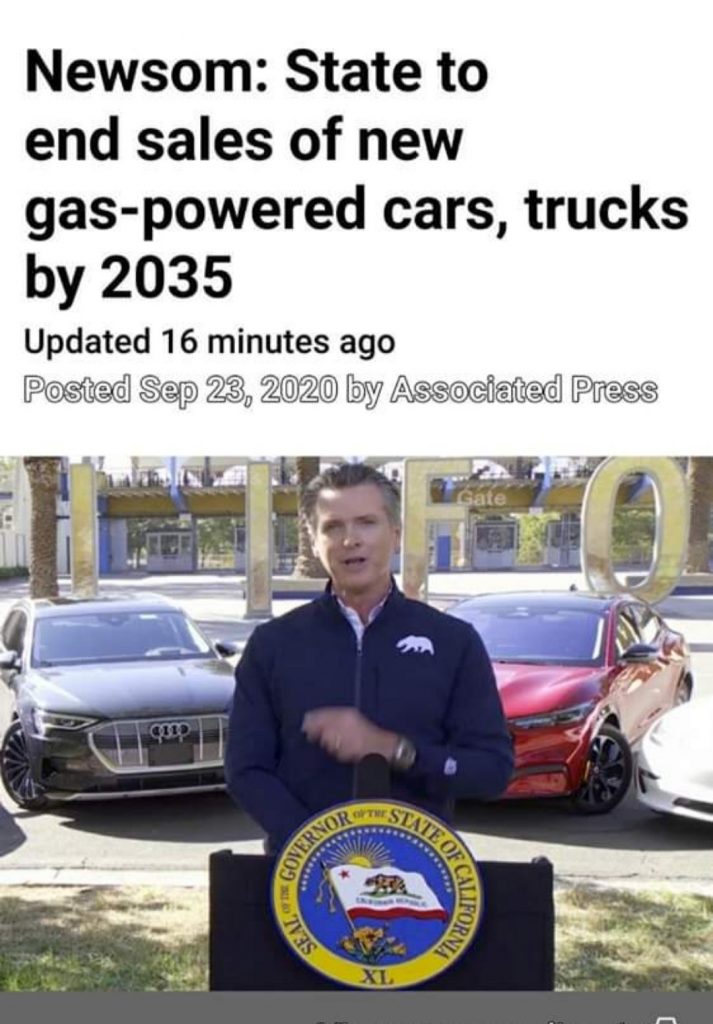
Gavin Newsom on Wednesday debuted a plan to ban sales of new gas-powered cars
by 2035 with a goal of reducing the state’s air pollution and combating climate
change. The executive order represents a big shift for car manufacturers and
will likely change how many Californians get from point A to B.
So what does it all mean for the common California
car owner? Here’s what you should know.
Can I keep my gas-powered car?
Short answer: yes. The governor’s office said
Wednesday that the order will not prevent Californians from owning
gasoline-powered cars. But the state is encouraging consumers to make the
switch, saying that the upfront cost of electric vehicles are projected to
match that of gas-powered ones in a matter of years, and the maintenance is
lower.
If you want to keep your Hummer, it’s up to you.
But if you want to buy a new one in California after 2035, it’ll have to be
electric.
Will I still be able to buy or sell a used gas-powered vehicle?
Yes. The order only applies to the sale of new
passenger cars and trucks, not used ones. Newsom also ordered that all medium
and heavy duty vehicles, such as school buses or freight trucks, be
zero-emission by 2045, where feasible.
Can I buy a new gas-powered car in another state and bring it to
California?
Yes you can. The order only affects the cars
purchased in California.
Will an electric car cost much more than a gas-powered one?
It depends on the make and model. Generally,
zero-emission cars are still more pricey than ones with internal-combustion
engines, but there are some affordable models. New Tesla vehicles, for example,
can run anywhere from $35,000 to $80,000 (although Elon Musk said this week a
$25,000 model is in the works). Other non-luxury models, like the Nissan Leaf,
Volkswagen e-Golf and Chevrolet Bolt retail for $30,000 to $36,000.
Proponents of zero-emissions vehicles are quick to
point out that it’s cheaper to own an electric model, both in terms of
maintenance and actual fuel. Chris Harto, senior transportation policy analyst
at the nonprofit Consumer Reports, said Californians can save about $1,000 a year
in fuel costs by switching to an electric vehicle.
“And, California drivers can save money
overall because lower fuel and maintenance costs will more than offset the
current price premium for electric vehicles,” Harto said in a statement.
Will more electric charging stations be added?
The governor’s executive order directs the
California Air Resources Board and other agencies to accelerate the deployment
of affordable fueling and charging options for zero-emission vehicles. In 2018,
zero emission vehicles, plug-ins and hybrids made up 12% of all new vehicles
sold in California, according to the California New Car Dealers Association. If
California wants to increase that rate to 100% of all new vehicles, it’s going
to create a significantly greater demand for charging stations.
Is this really happening?
If you’ve been following California’s climate news,
you’ll know that the state’s efforts to combat climate change don’t always go
over well with the Trump administration. California has been able to set its own
emissions standards for decades, but in recent years the president has
attempted to rescind that privilege, arguing that California’s policies are too
restrictive on car manufacturers. California sued the administration last year
over the dispute, and the case is still making its way through the courts. Some,
like Kelley Blue Book editor Matt DeLorenzo, say this latest executive order
could be struck down in the larger court ruling about California’s ability to
set its own emission standards.
“This latest move still has a long way to go
before implementation because it directs the California Air Resources Board to
issue the emission rules that will effectively bar the sale of these vehicles.
Beyond the question of whether or not California can set its own emissions will
certainly be the question of the ban violating the interstate commerce
clause,” DeLorenzo said in a statement.
The Alliance for Automotive Innovation, a lobbying
group that represents the world’s largest carmakers, said its members are “committed
to expanding vehicle electrification.”
But, it noted the change won’t be easy.
“Currently, electrified vehicles account for
less than 10% of new vehicle sales in California. While that is the best in the
nation, much more needs to be done to increase consumer demand for zero
emission vehicles in order for California to reach its goals. It will require
increased infrastructure, incentives, fleet requirements, building codes, and
much more. Auto Innovators is committed to working with California to expand
consumer adoption of electric vehicles,” the group’s president, John
Bozzella, said in a written statement.
Car dealers and representatives of the oil industry
were more critical.
The California Independent Petroleum Association
said the order will put thousands out of work and add more people to the
state’s already-stressed unemployment program. The California New Car Dealers
Association said it has many unanswered questions about the order. The
organization expressed concern that the order would exclude people who can’t
afford new electric cars.
“While we support the state’s goals to combat
climate change, there are many questions and factors that need to be
thoughtfully considered and addressed before implementing such a mandate on
consumers,” association President Brian Maas said in a
statement.
Royal Society of Arts,
London / Tel Aviv University, Tel Aviv
Coordinated Black Sky Resilience:
“Securing the Meta-Grid”
Assessing Progress; Considering (Essential) Next Steps
Today’s communities
are sustained by unprecedented technology, and by the all-sector
hyper-connectivity it has enabled:
By the “meta-grid,”
which has transformed our world.
However, this new
reality is not yet matched by the coordinated all-sector resilience essential
for our communities to survive a complex catastrophe.
Next Summit
EIS Summit XI Bicontinental
Postponed The
Eleventh Annual World Summit of Infrastructure Security, will be postponed
until Summer 2021 due to travel restrictions related to the COVID-19 outbreak.
Summer, 2021Royal Society of Arts,
London / Tel Aviv University, Tel Aviv
EPRO SECTOR is providing a forum for cross sector coordination addressing Black Sky Hazards. The government agencies, companies and other organizations listed below have become important contributors to EPRO SECTOR Executive Committee, and the cross sector, Black Sky coordination and planning process it hosts.
Facilitated tabletop exercises addressing Black Sky Hazards to critical infrastructures.
The EARTH EX® Black Sky Hazard Simulation Project (the Black Sky Project) is a moderated exercise series – a facilitated environment to consider impact and recovery from severe Black Sky Hazards – addressing national power grids and other critical infrastructures. The project exercises resilience and response recommendations from EPRO and other government and corporate planning initiatives, serving both as a “laboratory” – validating, refining and supplementing recommendations; and as an educational tool – a resource to help utilities and their partners with communication, training andconsensus building.
In an actual crisis scenario, utility and emergency agency managers who live through the crisis often document their takeaway “lessons-learned,” to guide improved resilience and response plans for future, similar crises. Black Sky Project exercises make possible a similar learning process, without living through an actual crisis. These adaptable, multi-sector or sector-unique facilitated tabletop exercises are designed to develop “lessons-imagined” for resilience and emergency response strategies addressing Black Sky Hazard scenarios.
Andy
Tang, Vice President – Energy Storage and Optimization, Wärtsilä
Published
Sept.
9, 2020
When all is said and done, we may look back on 2020 as the key
inflection point in the global transition to a more flexible, resilient, and
renewable grid. In
August, I wrote in Utility Dive how the European
experience during the pandemic is demonstrating how high renewable penetration,
flexible electricity markets will function in the not too distant future.
The recent experience in California offers another
glimpse into the emerging challenges facing utilities and grid operators as
they work to keep the lights on with an increasingly climate-strained
electric grid.
You are no doubt familiar with California’s recent
troubles. But the synopsis is this: a heatwave that saw temperatures climb
into triple digits had two compounding effects on the power grid, resulting in
the first rolling blackouts in California since the 2001 energy crisis. The
first was on demand. As temperatures rose, Californians cranked up the air
conditioning, increasing demand for power. But the extreme temperatures had an
impact on the ability of gas-fired generators to reliably deliver power, with
several even shutting down just as demand was peaking. Combined with the
evening decline of solar generated power, the California Independent System
Operator president called
this a “perfect storm” grid event.
What does this experience portend for the future of
a grid increasingly threatened by extreme weather events, such as heatwaves,
wildfires, hurricanes and more?
Microgrids – the ability to isolate and maintain
reliable power supply to critical load centers – are a potential solution to
many of the safety and reliability challenges facing utilities today. The
wildfire-necessitated public power shutoffs in PG&E’s service territory in
recent years offer an interesting possibility. By cutting power on high-risk
distribution and transmission lines, anything downstream will lose power. With
a battery-storage enabled microgrid, critical load pockets such as hospitals
would isolate from the grid. Now disconnected from the grid, that isolated
system would then form its own grid, managing frequency and voltage.
While the microgrid concept is not new, it has
proven a challenge to materialize in the real world. This is because the energy storage
technology required to form microgrids add complexity in the operation, optimization
and orchestration of grid assets that does not exist with traditional
centralized assets.
At Wärtsilä, our GEMS energy management software
platform optimizes the performance of individual energy storage and grid
integrated assets.
But from the beginning, we’ve always seen our platform as more than a single
power plant controller. We developed our software from the ground up to be
cloud based where a single power plant or storage asset would act as a single
node on a network with multiple nodes. Batteries add significant value to
grid operators, but they also add complexity. A network consisting of assets
from different technology providers will have different command and operation
protocols. Batteries require much more active management than a traditional
utility asset. Temperatures must be monitored to prevent thermal runaway. State
of charge must be constantly managed to ensure long-term safe operation.
Utilities already manage hundreds of thousands of data points. Managing the
operation of different battery technologies, with varying thresholds for safety
and discharge levels, is simply unrealistic.
We saw that as utilities added these new
distributed storage assets that there was a need for a control room tool that
could orchestrate these resources in a technology-agnostic way. This was the genesis of
our GEMS Fleet
Director platform. Fleet Director provides centralized, real-time
visibility and control into a global fleet of power plants. It is a cloud-based
platform that allows for secure monitoring of equipment, operation history, and
alarms from the fleet, power plant, and device level. Combining power plant
data aggregation, weather forecasts, region specific market data, renewable and
load forecasting, Fleet Director brings unparalleled intelligence to the
operation of utility assets.
Utilities have found
particular value in Fleet Director’s ability to seamlessly take
energy storage assets from grid control to microgrid control. That level of
control has proven to be the missing piece of the puzzle in making microgrids
truly viable. Having the capability to keep assets on the grid during normal
operations and isolate and manage critical load at the local level during high
risk events gives grid operators a level of flexibility and resiliency
previously unavailable.
With the control that Fleet Director offers,
multiple distributed storage systems can bond together and act as one resource.
This is the future that my colleagues at Wärtsilä are working toward for
California and beyond as more storage is added to the grid: a flexible,
resilient, and distributed fleet of assets that utilities can isolate and
safely operate during high-risk weather or grid events while maintaining
service to the most critical load.